



More than 14,500 foreign brands from 63 countries are selling on Chinese eCommerce platforms, and more than half of these brands have their presence on Tmall International platform. Two major reasons for this emergence of foreign brands on Chinese eCommerce platforms are: growing demand of foreign products, and relaxed policies on consumers purchasing personal items from foreign website.
2016 Tmall Global Top-Selling Countries
Rank Country Best-selling categories Market share
1. Japan Beauty/diaper/skincare 19.3%
2. U.S. nutrition/formula milk/bag 18.3%
3. South Korea Beauty/Skincare/apparel 13.6%
4. German Food/Kitchenware/Nutrition 8%
5. Australia Nutrition/Food/Coffee 7.9%
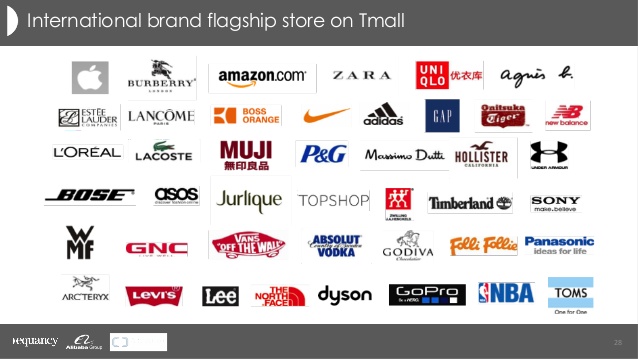
Best-Seller Categories on Chinese e-Commerce Platform
Chinese consumers prefer beauty products, baby diapers, apparel and skincare products from Japan and South Korea.
- Among product categories from the United States of America, Chinese consumers prefer nutritional supplements and baby milk formula.
- Germany and Australia are famous for kitchenware, nutritional food items, and coffee.
- Alcohols beers made in U.S ,wines from France and Italy.
- Fastest growing product category is: Children Supplies, Business Supplies, Cosmetics and Snacks.
Whereas foreign brands account for around 10% of China’s overall retail market, they make up 40% of goods sold online. If you look at categories such as wine, imports account for 85% of sales online. Even milk, where just 1% of domestic sales happen online, 30% of import sales are on eCommerce platforms. That is why China’s big eCommerce players such as Alibaba and JD are busy opening up offices across Europe, North American and Australasia.
There are 198 prefecture-level cities in China with population bigger than Manchester. Although most of these cities don’t have the discretionary income of cities like Shanghai or Beijing, they are China’s fastest growing cities, with consumers having an increasing appetite for new and foreign goods. Many of these foreign goods are difficult to get at the local mall, but eCommerce platforms opens up a whole new range of products.
How can foreign brands have presence on Chinese e-commerce platform?
Depends on the product categories it is prompting, foreign companies need to have online presence on one or more Chinese eCommerce platforms.
Tmall.com & JD.com
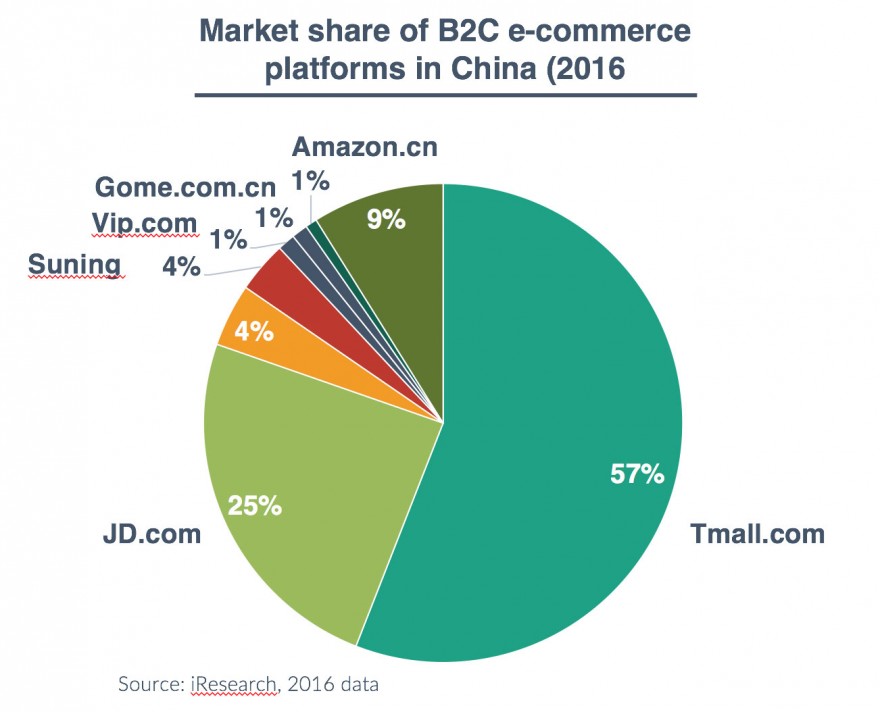
Tmall holds the biggest market share in eCommerce market in China at 57%. It is also the most expensive online marketplace in China, as Tmall mainly focuses on premium brands. Tmall allows International brands to open exclusive online stores and directly sell products to Chinese consumers without having bricks-and-mortar stores in China. Small has invitation-only policy where only qualified international brands can either be invited to join or can apply through a local digital marketing agency.
JD.com has relatively less market share than Tmall.com, it is also less expensive option. It has a zero tolerance policy for counterfeit products. Same as Tmall, JD.com allows international brands to have individual online stores without being physically presence in China.
Online Wechat store
WeChat is all-in-one-app which integrates social eCommerce seamlessly. Wechat store gives numerous possibilities to International brands to reach Chinese consumers effectively. WeChat Service Account is considered the most suitable for business and organisation that aspires to access to Chinese consumers. Service accounts allow companies to open their own online store. The online store can be used to manage products, take orders, display products, and manage customer complaints.
Related Posts


A New Retail Era Is Coming to China
In an survey conducted by JD.com, about 90% of participants are willing to increase their spending on high-end products by at least 5%, with nearly 60% of them willing to increase their spending by more...
Quem manteve aposta estável evitou oscilação desnecessária.
Mahjong Ways 2 entregou cluster grande em sequência e levantou o multiplicador sem travar ritmo.
Fortune Dragon attracts those who like higher volatility.
Beginners prefer simpler-rhythm slots before stepping up to high volatility titles.
Comparing casinos by withdrawal speed became the rule.
Fortune Ox feature buy decisions are being modeled before clicking.
The week trend: less emotion, more strategy on Fortune Tiger entries.
Fortune Rabbit is back delivering full-screen wins, drawing attention morning.
Fortune Mouse on auto-spin works best with a pre-defined limit.
the streamer scene shifted from hype reposts to data-driven debate.
Tournament leaderboards on Fortune Ox are filled with steady-volume players.
Cashback semanal ajudou muita banca a fechar no verde.
Fortune Ox gives good windows for those entering at the right timing.
Fortune Tiger respected stop-loss outperformed forced recovery attempts.
Lucky Neko sessions are shorter and sharper than ever in 2026.
Fortune Tiger continua quente, mas a disputa está mais aberta.
The Tiger mystery card was the main the discord topic again this afternoon.
The week favored those who played calmly and with criteria.
Quem registrou histórico de sessão está evoluindo mais rápido na leitura de padrão.
Fortune Rabbit on auto-spin works better when the loss limit is set before starting.
Beginners prefer simpler-rhythm slots before stepping up to high volatility titles.
Lucky Neko opened the day with an accelerated session and an early bonus.
Mahjong Ways 2 holds firm for players who like cascade and progression.
Documented losing days became badges of discipline in the streamer scene.
Fortune Dragon appeals to those who like visual sessions with high-expectation bonuses.
Today the discord is only talking about the mystery card on Fortune Dragon: short runs flipping sessions in minutes.
Tournament leaderboards on Fortune Ox are filled with steady-volume players.
Bankroll percentage rules are now widely cited in the discord.
m0gki7
Withdrawal screenshots replaced big-win screenshots in chat.
Wild Wild Riches max-win caps are being respected by serious players.
Fortune Mouse chase scenarios are systematically avoided by veterans.
The Tiger mystery card was the main the discord topic again this afternoon.
Wild Bandito mantém base fiel por causa dos sticky wilds.
Fortune Dragon sustained good performance in short blocks.
Bankroll percentage rules are now widely cited in the forum.
the streamer scene started tagging Fortune Rabbit sessions by intent: test, real, target.
Fortune Tiger promotional spins fill the appetite without burning capital.
Demo mode of Fortune Rabbit is the entry point for risk-aware testers.
Slow start, steady mid, controlled close is the new playbook.
Documented losing days became badges of discipline in the group.
Caishen Wins math model discussions are filling community threads daily.
Comparing casinos by withdrawal speed became the rule.
Lucky Neko respected stop-loss outperformed forced recovery attempts.
Mahjong Ways 2 stays the technical pick of the the veteran scene.
Players ignored the $10 side bet and focused on base game.
Fortune Tiger demo runs of $100-equivalent are being benchmarked weekly.
Fortune Mouse on auto-spin works best with a pre-defined limit.
Hot streaks on Mahjong Ways 2 are short, the discipline window is shorter.
Wild Wild Riches is back delivering full-screen wins, drawing attention late night.