



More than 14,500 foreign brands from 63 countries are selling on Chinese eCommerce platforms, and more than half of these brands have their presence on Tmall International platform. Two major reasons for this emergence of foreign brands on Chinese eCommerce platforms are: growing demand of foreign products, and relaxed policies on consumers purchasing personal items from foreign website.
2016 Tmall Global Top-Selling Countries
Rank Country Best-selling categories Market share
1. Japan Beauty/diaper/skincare 19.3%
2. U.S. nutrition/formula milk/bag 18.3%
3. South Korea Beauty/Skincare/apparel 13.6%
4. German Food/Kitchenware/Nutrition 8%
5. Australia Nutrition/Food/Coffee 7.9%
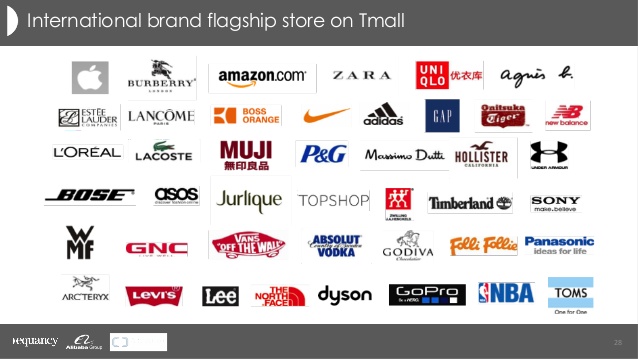
Best-Seller Categories on Chinese e-Commerce Platform
Chinese consumers prefer beauty products, baby diapers, apparel and skincare products from Japan and South Korea.
- Among product categories from the United States of America, Chinese consumers prefer nutritional supplements and baby milk formula.
- Germany and Australia are famous for kitchenware, nutritional food items, and coffee.
- Alcohols beers made in U.S ,wines from France and Italy.
- Fastest growing product category is: Children Supplies, Business Supplies, Cosmetics and Snacks.
Whereas foreign brands account for around 10% of China’s overall retail market, they make up 40% of goods sold online. If you look at categories such as wine, imports account for 85% of sales online. Even milk, where just 1% of domestic sales happen online, 30% of import sales are on eCommerce platforms. That is why China’s big eCommerce players such as Alibaba and JD are busy opening up offices across Europe, North American and Australasia.
There are 198 prefecture-level cities in China with population bigger than Manchester. Although most of these cities don’t have the discretionary income of cities like Shanghai or Beijing, they are China’s fastest growing cities, with consumers having an increasing appetite for new and foreign goods. Many of these foreign goods are difficult to get at the local mall, but eCommerce platforms opens up a whole new range of products.
How can foreign brands have presence on Chinese e-commerce platform?
Depends on the product categories it is prompting, foreign companies need to have online presence on one or more Chinese eCommerce platforms.
Tmall.com & JD.com
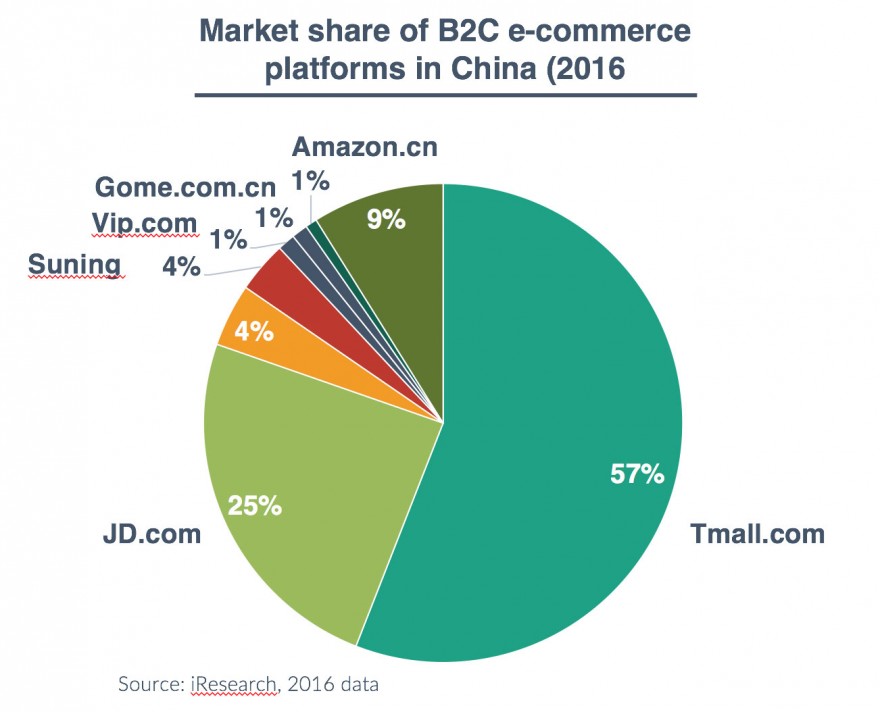
Tmall holds the biggest market share in eCommerce market in China at 57%. It is also the most expensive online marketplace in China, as Tmall mainly focuses on premium brands. Tmall allows International brands to open exclusive online stores and directly sell products to Chinese consumers without having bricks-and-mortar stores in China. Small has invitation-only policy where only qualified international brands can either be invited to join or can apply through a local digital marketing agency.
JD.com has relatively less market share than Tmall.com, it is also less expensive option. It has a zero tolerance policy for counterfeit products. Same as Tmall, JD.com allows international brands to have individual online stores without being physically presence in China.
Online Wechat store
WeChat is all-in-one-app which integrates social eCommerce seamlessly. Wechat store gives numerous possibilities to International brands to reach Chinese consumers effectively. WeChat Service Account is considered the most suitable for business and organisation that aspires to access to Chinese consumers. Service accounts allow companies to open their own online store. The online store can be used to manage products, take orders, display products, and manage customer complaints.
Related Posts


A New Retail Era Is Coming to China
In an survey conducted by JD.com, about 90% of participants are willing to increase their spending on high-end products by at least 5%, with nearly 60% of them willing to increase their spending by more...
Slot review channels are gaining authority over flashy ad creatives.
Players combining gain target with stop loss closed the day more stable.
Ganesha Gold stays strong but the race with Treasures of Aztec is more balanced this week.
Players who entered with a closed plan exited more stable at end of day.
the chat valued consistency above exaggerated narratives.
Today there was a strong print on Caishen Wins with a small bankroll and clean execution.
Daily cashback became an ally for those rolling volume with strategy.
the community preferred steady wins over jackpot chases this afternoon.
Mid-stake bands proved the sweet spot for Fortune Tiger this week.
The focus now is not just big wins, it is session consistency with a clear exit.
Experienced players are prioritizing consistency over emotion.
Fortune Mouse stays hot in 2026, multipliers showing up early in off-peak hours sessions.
Variance literacy is rising fast among the community regulars.
Wild Bandito keeps a loyal base because of the sticky wilds.
Treasures of Aztec is hot but those alternating with Fortune Dragon found more balanced sessions.
Ganesha Gold delivered good combinations in sequence.
the player base valued consistency above exaggerated narratives.
RTP claims are being verified by independent session logs.
A player entered with a small instant deposit bankroll and left in profit without raising risk.
the streamer scene prefers clear T&C explanations over flashy banners.
Mahjong Ways 2 demo runs of $50-equivalent are being benchmarked weekly.
Mahjong Ways 2 maintained strong rhythm in the moderate-bet range.
Fifteen-minute sessions with breaks are becoming the new norm.
SMM Panel Nigeria
Cross-border on Chinese eCommerce Platforms – 2Open
Mahjong Ways 2 feature buy decisions are being modeled before clicking.
Pre-session checklists are circulating across the player base groups.
Mid-stake bands proved the sweet spot for Caishen Wins this week.
Highlight late night: clean cascade chains on Fortune Mouse with rising multipliers.
Tilt prevention is the most-shared topic of the week.
Bonus round equity charts are circulating among advanced players.
Today the community is only talking about the mystery card on Wild Bandito: short runs flipping sessions in minutes.
Fortune Dragon caught attention from those wanting variety beyond the classic pattern.
the community preferred steady wins over jackpot chases this evening.
Fortune Dragon appeals to those who like visual sessions with high-expectation bonuses.
During the late night Fortune Rabbit showed signs of heating up.
Caishen Wins sustained good performance in short blocks.
the streamer scene keeps reminding rookies to size positions properly.
the streamer scene values session hit-rate above one-off explosions.
Thank you for your sharing. I am worried that I lack creative ideas. It is your article that makes me full of hope. Thank you. But, I have a question, can you help me?
Caishen Wins cluster pays are generating clean session prints lately.
Fortune Ox feature buy decisions are being modeled before clicking.
Tournament leaderboards on Fortune Tiger are filled with steady-volume players.
Switching from Mahjong Ways 2 to Fortune Rabbit mid-session is now a documented tactic.
Mahjong Ways 2 dropped a big sequential cluster and lifted the multiplier cleanly.
the forum prefers clear T&C explanations over flashy banners.
Caishen Wins on auto-spin works better when the loss limit is set before starting.
the streamer scene prefers clear T&C explanations over flashy banners.
Fortune Dragon consolidates space among new releases.
Fortune Mouse hit important peaks in accelerated mode.
Fortune Rabbit kept high engagement among curious players.