



More than 14,500 foreign brands from 63 countries are selling on Chinese eCommerce platforms, and more than half of these brands have their presence on Tmall International platform. Two major reasons for this emergence of foreign brands on Chinese eCommerce platforms are: growing demand of foreign products, and relaxed policies on consumers purchasing personal items from foreign website.
2016 Tmall Global Top-Selling Countries
Rank Country Best-selling categories Market share
1. Japan Beauty/diaper/skincare 19.3%
2. U.S. nutrition/formula milk/bag 18.3%
3. South Korea Beauty/Skincare/apparel 13.6%
4. German Food/Kitchenware/Nutrition 8%
5. Australia Nutrition/Food/Coffee 7.9%
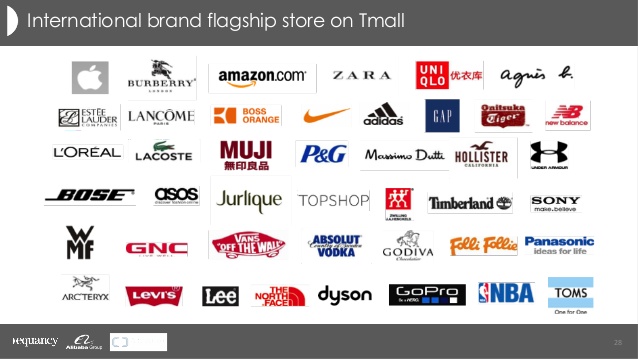
Best-Seller Categories on Chinese e-Commerce Platform
Chinese consumers prefer beauty products, baby diapers, apparel and skincare products from Japan and South Korea.
- Among product categories from the United States of America, Chinese consumers prefer nutritional supplements and baby milk formula.
- Germany and Australia are famous for kitchenware, nutritional food items, and coffee.
- Alcohols beers made in U.S ,wines from France and Italy.
- Fastest growing product category is: Children Supplies, Business Supplies, Cosmetics and Snacks.
Whereas foreign brands account for around 10% of China’s overall retail market, they make up 40% of goods sold online. If you look at categories such as wine, imports account for 85% of sales online. Even milk, where just 1% of domestic sales happen online, 30% of import sales are on eCommerce platforms. That is why China’s big eCommerce players such as Alibaba and JD are busy opening up offices across Europe, North American and Australasia.
There are 198 prefecture-level cities in China with population bigger than Manchester. Although most of these cities don’t have the discretionary income of cities like Shanghai or Beijing, they are China’s fastest growing cities, with consumers having an increasing appetite for new and foreign goods. Many of these foreign goods are difficult to get at the local mall, but eCommerce platforms opens up a whole new range of products.
How can foreign brands have presence on Chinese e-commerce platform?
Depends on the product categories it is prompting, foreign companies need to have online presence on one or more Chinese eCommerce platforms.
Tmall.com & JD.com
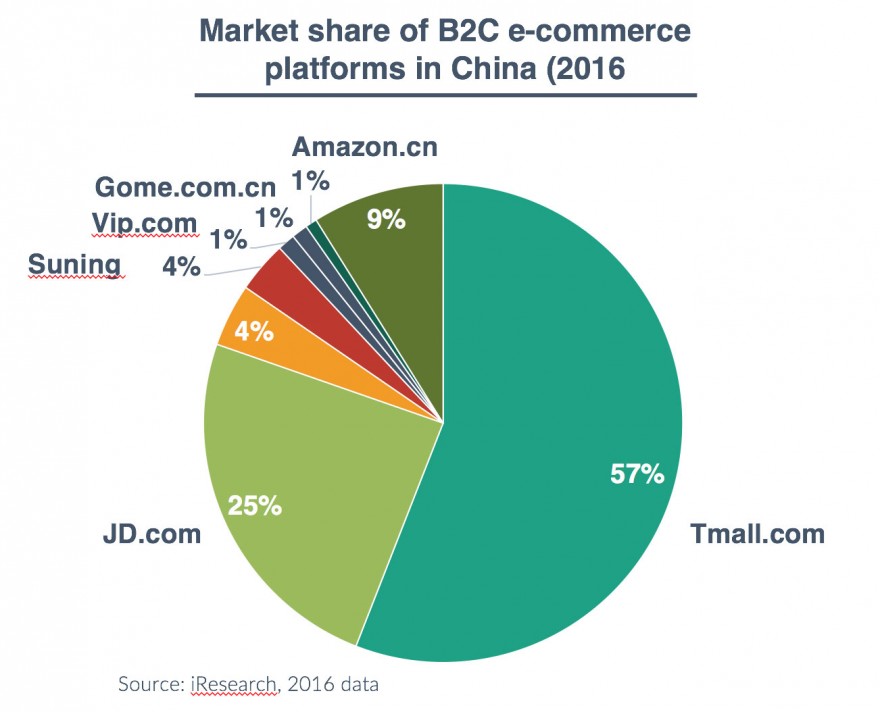
Tmall holds the biggest market share in eCommerce market in China at 57%. It is also the most expensive online marketplace in China, as Tmall mainly focuses on premium brands. Tmall allows International brands to open exclusive online stores and directly sell products to Chinese consumers without having bricks-and-mortar stores in China. Small has invitation-only policy where only qualified international brands can either be invited to join or can apply through a local digital marketing agency.
JD.com has relatively less market share than Tmall.com, it is also less expensive option. It has a zero tolerance policy for counterfeit products. Same as Tmall, JD.com allows international brands to have individual online stores without being physically presence in China.
Online Wechat store
WeChat is all-in-one-app which integrates social eCommerce seamlessly. Wechat store gives numerous possibilities to International brands to reach Chinese consumers effectively. WeChat Service Account is considered the most suitable for business and organisation that aspires to access to Chinese consumers. Service accounts allow companies to open their own online store. The online store can be used to manage products, take orders, display products, and manage customer complaints.
Related Posts


A New Retail Era Is Coming to China
In an survey conducted by JD.com, about 90% of participants are willing to increase their spending on high-end products by at least 5%, with nearly 60% of them willing to increase their spending by more...
Tournament leaderboards on Fortune Mouse are filled with steady-volume players.
the community preferred steady wins over jackpot chases this evening.
The market is rewarding disciplined players, not just aggressive ones.
Defining a unit size before Fortune Rabbit sessions is now best practice.
The week trend: less emotion, more strategy on Fortune Mouse entries.
During the afternoon Caishen Wins showed signs of heating up.
Today there was a strong print on Caishen Wins with a small bankroll and clean execution.
A $50 instant deposit unlocked the bonus round and left budget to test Treasures of Aztec after.
Highlight evening: clean cascade chains on Treasures of Aztec with rising multipliers.
Discipline is the only consistent edge across all Fortune Rabbit variants.
Switching from Mahjong Ways 2 to Fortune Rabbit mid-session is now a documented tactic.
Cashout discipline determines monthly P&L more than entry skill.
Provider variance benchmarks are getting standardized references.
Between hype and strategy, control plus opportunity still wins.
Fortune Rabbit hit important peaks in accelerated mode.
Mahjong Ways 2 stays a solid choice for technical play.
Fortune Tiger stays hot but the dispute is more open now.
Mahjong Ways 2 delivered consistency on short respins through the morning.
A $50 PayPal unlocked the bonus round and left budget to test Caishen Wins after.
Tournament leaderboards on Fortune Rabbit are filled with steady-volume players.
Lucky Neko kept presence in the evening sessions.
Fortune Ox hit-frequency talk has overtaken jackpot-chase talk.
Defining a unit size before Wild Wild Riches sessions is now best practice.
The Tiger mystery card was the main the forum topic again this off-peak hours.
Treasures of Aztec max-bet caps during bonus are being reviewed by regulators.
the discord is comparing time-to-bonus more than just the final multiplier.
Fortune Tiger mid-tier wins are being celebrated as much as mega-wins.
Treasures of Aztec stays hot in 2026, multipliers showing up early in peak hours sessions.
Lucky Neko respected stop-loss outperformed forced recovery attempts.
PG Soft 2026 has a deep catalog for rotating two or three titles per session.
e-wallet entry and fast withdrawal still lead the choices.
Today was not an all-in day, it was an execution day: moderate entry, target exit.
Fortune Ox sustained good performance in short blocks.
Players who alternated Fortune Ox and Fortune Tiger reported more balanced sessions.
Players ignored the $20 side bet and focused on base game.
Fortune Ox gives good windows for those entering at the right timing.
Caishen Wins sustained good performance in short blocks.
Players who alternated Mahjong Ways 2 and Fortune Dragon reported more balanced sessions.
PG Soft 2026 has a deep catalog for rotating two or three titles per session.
the group is comparing time-to-bonus more than just the final multiplier.
PG Soft 2026 has a deep catalog for rotating two or three titles per session.
the regular crowd prefers clear T&C explanations over flashy banners.
Solo focus on Fortune Dragon works only when the rhythm allows it.
Instant card plus active bonus is still the most demanded combo for fast entries.
Treasures of Aztec opened the day with an accelerated session and an early bonus.
Provider transparency on Fortune Tiger math has improved this year.
Fortune Dragon earned space among players who prefer respins with predictable rhythm.
the regular crowd prefers clear T&C explanations over flashy banners.
massage therapy
Cross-border on Chinese eCommerce Platforms – 2Open
Live streams of Fortune Tiger trended again thanks to the more dynamic broadcast feel.